Connect multiple devices without an additional switch
The ServiceGate V2 supports remote access, datalogging and monitoring. Access your connected machines remotely and make their measurement data usable for dashboards and trends.
Our team coordinates the data readout and configuration based on your equipment and the desired measurement values. Discover the possibilities of datalogging and monitoring.
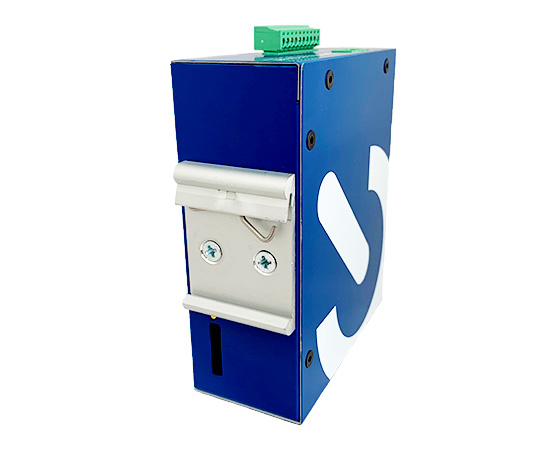
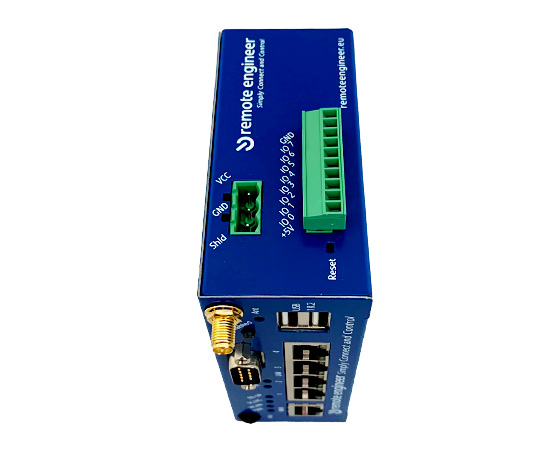
This model allows you to connect multiple devices without an additional switch. For example, a configuration with a PLC, HMI and a robotic arm can be accessed remotely with the ServiceGate V2. This model has 4 LAN ports, 8 GPIO connections, standard Wi-Fi and a serial port.
The client software creates a VPN connection to the ServiceGate you selected in the web portal. From then on, you are directly connected to the devices connected to the ServiceGate V2 at that location.
LTE (4G)
Sometimes the environment demands a connection over the 4G network. The ServiceGate V2 is equipped with an additional module, which allows connecting to the Internet with a SIM card. For optimal coverage, an additional LTE antenna is also included with the router.
Configuration
We supply the ServiceGate V2 standard with connectors for power and I/O (Input/Output), a network cable and a WiFi antenna. The router is configured using an Internet browser. This can be any browser, but we recommend Google Chrome. Connect to the ServiceGate V2 easily with your computer, tablet or smartphone.
Specifications
| Processor | ATHEROS |
| RAM | 64MB |
| Flash | 8MB |
| Ethernet | 1x Fast Ethernet (WAN) |
| Ethernet (LAN) | 2x Fast Ethernet (LAN) |
| Wi-Fi | IEEE 802.11 b/g/n |
| Serial port | RS-232/422/485(DB9) |
| USB | 2x USB 2.0 |
| 4G/LTE | Optional |
| Certification | UL 60950-1 |
| CE Class A | |
| Warranty | 12 months |
| Dimensions | (LxWxH) 121x98x46 mm |
| Weight | +/- 350 g |
| Mounting | DIN rail |
| Housing | Metal IP30 |
| Power consumption | 18 Watt/8-48 VDC input |
| Operating temperature | -5 – +55°C |
| Storage temperature | -30 – +60°C |
| Ambient humidity | 5 to 95% (30°C, non-condensing) |
| Wireless standards | IEEE 802.11n, IEEE 802.11g, IEEE 802.11b |
| Frequency range | 2.400GHz — 2.4835GHz |
| Data rates | IEEE 802.11 b Standard mode: 1, 2, 5.5, 11 Mbps |
| IEEE 802.11g Standard Mode: 6,9,12,18,24,36,48,54Mbps | |
| IEEE 802.11n : 65Mbps @ HT20 | |
| 150Mbps @ HT40 | |
| Receiver sensitivity | 135M: -65 dBm @ 10% PER (MCS7) |
| 72.2M: -70dBm @ 10% PER(MCS7) | |
| 54M: -75dBm @ 10% PER | |
| 11M: -86dBm @ 8% PER | |
| Modulation technique | 802.11 Legacy b/g |
| DSSS (DBPSK, DQPSK, CCK) | |
| OFDM (BPSK, QPSK, 16-QAM, 64-QAM) | |
| Wireless security | WPA/WPA2, WEP, TKIP and AES |
| Transmit power | IEEE 802.11n: 14 dBm @ HT40 MCS7 |
| IEEE 802.11b: 18dBm | |
| Operating modes | Ad-Hoc/Infrastructure mode/AP/Repeater/UART |

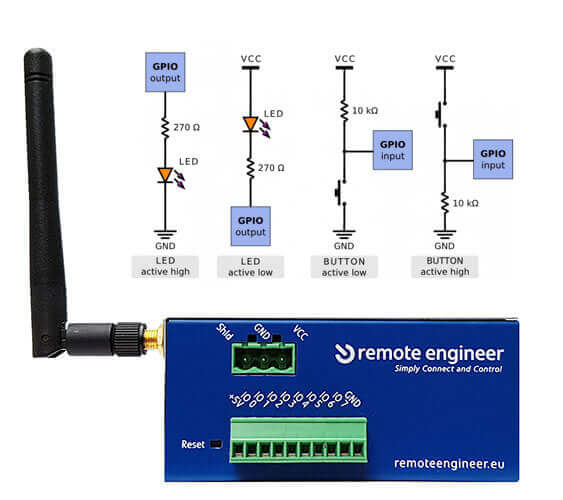
Input/Output
GPIO stands for General Purpose Input and Output, also known as I/O. This function is used to communicate between the ServiceGate router and the system(s) in question. We can pre-configure the settings for these; you can, of course, set them yourself.
The ServiceGate V2 has eight input/output ports.
Secure access needs configuration and ongoing management
An encrypted VPN connection protects traffic between the tunnel endpoints. That protection does not automatically cover all communication behind the router. Combine the connection with appropriate user permissions, network segmentation and an agreed firewall profile. Keep the software and firmware of connected machines and control systems up to date too.