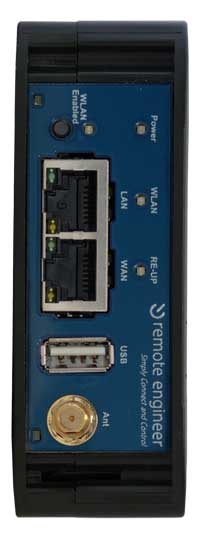



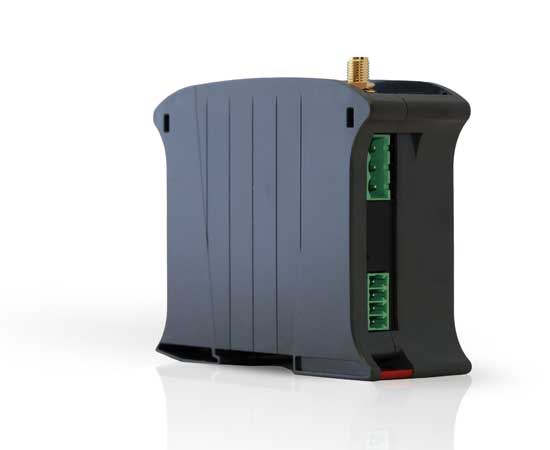
The VPN router for smaller machines and projects
What makes our ServiceGate Nano attractive to you as a machine builder or installer? Simple: you can save time and money by providing remote support at an attractively low investment. This industrial VPN router is particularly suitable for smaller machines or projects. We developed the ServiceGate Nano as part of the Remote Engineer Support solution. The associated client software creates a VPN connection to the ServiceGate you selected. Your PC is then directly connected to the devices connected to the ServiceGate Nano.
Configuration
We supply the ServiceGate Nano standard with connectors for power and I/O, a network cable and a Wi-Fi antenna. The ServiceGate Nano is configured using an Internet browser. This may be any Internet browser, but we recommend Google Chrome. Moreover, to connect to the Nano, you need a computer, tablet or smartphone.

Input/Output
GPIO stands for General Purpose Input and Output, also known as I/O. This function is used to communicate between the ServiceGate and underlying systems. Signals are received and transmitted. We are happy to configure the settings of this for you, but you can also set it up yourself. The ServiceGate Nano has one input and one output.
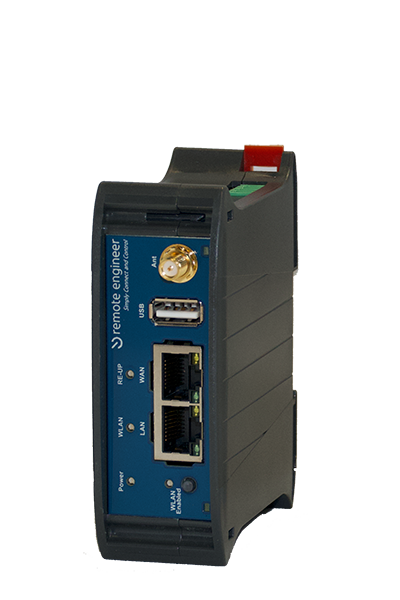
Specifications
| Processor | ATHEROS |
| RAM | 64MB |
| Flash | 8MB |
| Ethernet | 1x Fast Ethernet (WAN) |
| Ethernet (LAN) | 4x Fast Ethernet (LAN) |
| Wifi | IEEE 802.11 b/g/n |
| Serial port | RS-232/422/485(DB9) |
| USB | No2x USB 2.0 |
| 4G/LTE | Optional |
| Certificates | UL 60950-1 |
| Certificates | CE Class A |
| Warranty | 12 months |
| Dimensions | (LxWxH) 100x80x35 mm |
| Weight | +/- 50 gr. |
| Mounting | DIN Rail (for DIN rail version EN 50022) |
| Housing | Plastic |
| Power consumption | 8-48 VDC input |
| Operating temperature | -5 – +55°C |
| Storage temperature | -30 – +60°C |
| Ambient humidity | 5 to 95% (30°C, non-condensing |
Data ratesIEEE802.11 b Standard Mode: 1,2,5,5,11Mbps
| Wireless standards | IEEE 802.11n, IEEE 802.11g, IEEE 802.11b |
| Frequency range | 2.400GHz – 2.4835GHz |
| Data rates | IEEE 802.11 b Standard Mode: 1,2,5,5,11Mbps |
| IEEE 802.11g Standard Mode: 6,9,12,18,24,36,48,54Mbps | |
| IEEE 802.11n : 65Mbps @ HT20 | |
| 150Mbps @ HT40 | |
| Receiver Sensitivity | 135M: -65dBm @ 10% PER(MCS7) |
| 72.2M: -70dBm @ 10% PER(MCS7) | |
| 54M: -75dBm @ 10% PER | |
| 11M: -86dBm @ 8% PER | |
| Modulation Technique | 802.11 Legacy b/g |
| DSSS (DBPSK, DQPSK, CCK) | |
| OFDM (BPSK, QPSK, 16-QAM, 64-QAM) | |
| Wireless Security | WPA/WPA2, WEP, TKIP and AES |
| Transmit power | IEEE 802.11n: 14dBm @ HT40 MCS7 |
| IEEE 802.11b: 18dBm | |
| Working Mode | Ad-Hoc/Infrastructure Mode/AP/Repeater/UART |