


IEC 60870-5-104
Last updated on 29 April 2026
IEC 60870-5-104 is the protocol widely used in energy and infrastructure networks for telecontrol and SCADA. In this article, we explain exactly what IEC 104 does, which features are important, and how Remote Engineer applies this protocol.
What is IEC 60870-5-104
IEC 60870-5-104 (short: IEC 104) is the Ethernet/TCP/IP extension of the older serial IEC 60870-5-101 protocol. It is specifically designed for telecontrol and telemetry. It enables the real-time exchange of measured values, status information, and control commands between control centers (the client) and field devices such as RTUs and IEDs (the servers).
Who Communicates with Whom
In a standard setup, roles are divided between the client (central SCADA) and the server (RTU or IED). The client initiates sessions and polls, while servers can also send spontaneous messages during significant events. IEC 104 operates over standard TCP/IP networks and typically uses port 2404.
Our application
Remote applies the IEC 60870-5-104 protocol by deploying our routers, such as the ServiceGate or SmartController, as a server within the network. In this configuration, the client can send commands to the router, which receives and processes these messages immediately.
Are you specifically looking for the hardware implementation? Then please read our extensive article on the IEC 60870-5-104 remote access solution.
A valuable addition to this solution is that our hardware, acting as a server, is also capable of sending spontaneous messages during specific events or status changes. This allows the client to be notified immediately of changes in the field without having to continuously wait for the next polling cycle.
This offers various possibilities for local control and data exchange:
- Direct I/O control: The router can use the GPIO ports or serial interfaces to read or control physical values based on the IEC 104 instructions.
- Protocol conversion: We can locally translate the IEC 104 protocol to a Modbus server. This makes it possible to easily read or write data from other industrial systems that do not natively support IEC 104.
In this way, our hardware serves as a flexible and secure bridge between the traditional IEC 104 protocol and your modern installations.
Key Features of IEC 104
- Based on TCP/IP: Communication lines run over IP, enabling long distances and modern network architectures.
- Client-Server structure: The central SCADA acts as a client; RTUs/IEDs act as servers that respond but can also send spontaneous messages.
- Standardized information objects: Data is exchanged as Information Objects with ASDU and IOA addressing (ASDU addresses and IOA).
- Real-time & event-driven: Supports periodic polling and spontaneous messages for rapid reporting.
- Reliable transmission: Sequence numbering, acknowledgments, and retransmissions make communication robust, even on unstable networks.
- Specific to energy: IEC 104 is tailored for grid management, substation automation, and critical infrastructures.
Technical Terms You should Know
Important terms are ASDU (Application Service Data Unit), IOA (Information Object Address), Information Object, Common Address, and timestamps (timestamps via NTP or protocol). For transport, you often see TCP/IP and the well-known port 2404.
Supported Devices and Applications
IEC 104 can be found on various devices and in different systems. Here’s an overview:
| Application / device | Description |
|---|---|
| RTUs (Remote Terminal Units) | Devices in substations that exchange measurement values, status information, and commands with the central station. |
| IEDs (Intelligent Electronic Devices) | Smart protection and measurement devices that natively support IEC 104. |
| SCADA systems | Central systems that function as clients and receive, process data, and send control commands. |
| Gateways / Protocol converters | Devices that convert, for example, Modbus or IEC 101 to IEC 104 for IP communication. |
| Network components in energy installations | Switching stations, measurement units, and protection relays that speak IEC 104 for direct SCADA connection. |
Setting up an IEC 104 Environment
When setting up, focus on network, addressing, time synchronization, and security. Below are the practical steps you always check:
1. Network connection
IEC 104 uses port 2404 over TCP/IP. The client connects to the server; ensure that firewalls allow traffic on port 2404 and that routing is correctly configured.
2. Configure addressing
Each device gets a unique Common Address, and each data point has an Information Object Address (IOA). Verify that ASDU addresses and IOAs from field equipment exactly match the SCADA configuration.
3. Direction and spontaneous notifications
The client initiates the session, but servers can also send spontaneous messages during malfunctions or status changes. Carefully configure buffer lengths and settings for spontaneous transmission.
4. Time settings and synchronization
IEC 104 supports timestamps. Use NTP or protocol-based synchronization to ensure events are correctly logged chronologically.
5. Security and segmentation
The original standard has no built-in encryption. For modern networks, implement cybersecurity measures such as VPN, firewalls, and network segmentation. Also consider IEC 62351 for encryption and authentication.
Since security is often an underestimated issue with this protocol, we have written an in-depth analysis regarding IEC 60870-5-104 security.
6. Testing and monitoring
After configuration, test the connection with SCADA software or special IEC 104 test tools. Check ASDU and IOA addressing, confirmation mechanisms, and whether messages arrive within expected time. For central data storage and logging, you can also look at solutions for remote access and datalogging to keep reporting and history centralized.
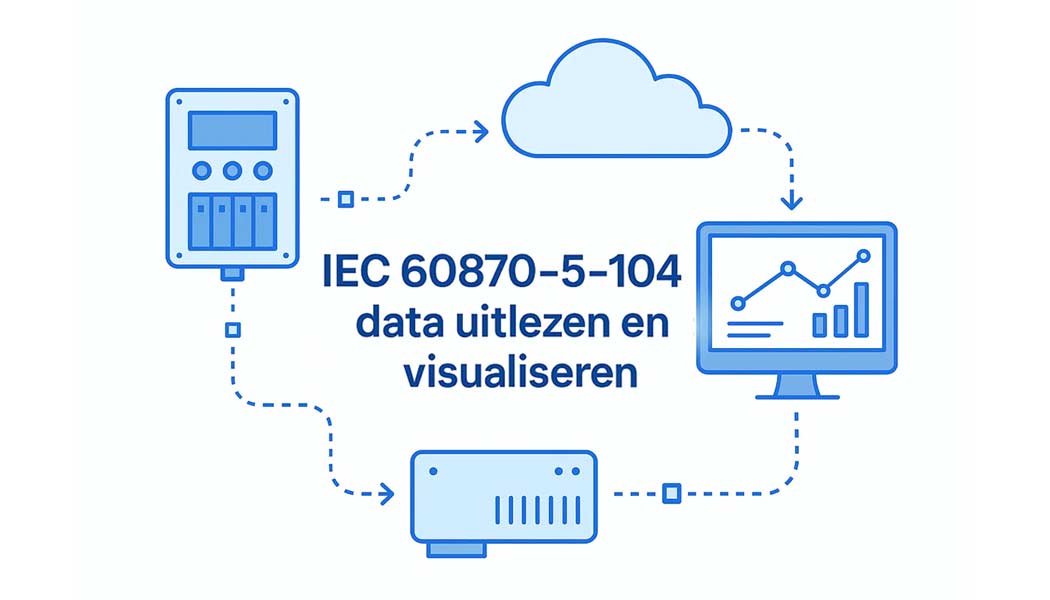
Is the connection stable? Then read our guide on how to subsequently read and visualize IEC 60870-5-104 data in dashboards.
Practical Tips and Pitfalls
– Always check if port 2404 is open in both network and host firewalls.
– Watch for overlaps in ASDU/IOA addresses with multiple RTUs.
– Test spontaneous notifications with realistic fault scenarios.
– Use NTP and check timestamps after daylight saving time changes.
Where IEC 104 is Mainly Used
IEC 104 is primarily seen in high and medium voltage stations, substations, hydroelectric power plants, and SCADA environments of utility companies. It is increasingly being applied in infrastructure projects such as tunnels, bridges, and water management installations.
In Summary
IEC 60870-5-104 combines the robust data structure of the classic IEC 101 with the modern advantages of TCP/IP transport. It is an essential protocol for critical infrastructure thanks to the use of standardized objects (ASDU/IOA) and support for both polling and spontaneous reporting.
Remote elevates this standard by positioning the router as an intelligent server within the network. Consequently, our hardware serves not only as a communication channel but as an active bridge that enables direct I/O control and local protocol conversion to Modbus. Through careful configuration of the client-server relationship, timestamps, and layered security (such as VPN and firewalls), Remote Engineer acts as the link to a future-proof and secure IEC 104 environment.
Looking for this specific or a similar solution? Please contact us for further information or to set up a joint testing phase.